Kumospace's Business plan costs $16 per member per month ($12.80 on annual billing) with a 5-seat minimum, and the free plan stops at 5 registered members on one floor. This article compares five alternatives, using prices taken from each vendor's official pricing page on September 24, 2026: Gather, SoWork, Tandem, WorkAdventure, and Hiroba. We build Hiroba, so we've kept the table and the selection criteria neutral enough to be useful whichever one you pick.
Comparison table
Prices are per user per month in USD, as shown on official pricing pages on September 24, 2026. Where a vendor shows both, the monthly rate is listed first and the annual-billing rate in parentheses. The table scrolls horizontally on small screens. Check each vendor's page before signing a contract; this category changes prices often.
| Product | Paid price | Billing unit | Free plan | 10 people, monthly billing | Video meetings | Runs as | Self-hosting |
|---|---|---|---|---|---|---|---|
| Kumospace | $16 ($12.80 annual) | Registered member, 5-seat minimum | Up to 5 members, 1 floor. 14-day Business trial | $160 | Yes, with recording | Browser, desktop app, mobile app | No |
| Gather | $15 ($12 annual) | Registered member | None. 30-day trial, up to 50 people, no card | $150 | Yes, with recording and transcription | Browser, desktop app, mobile app | No |
| SoWork | Basic $6 ($5.40 annual), Premium $15 ($12 annual) | Registered member | Up to 10 members, 30-minute meeting cap. 7-day trial | $60 (Basic) / $150 (Premium) | Yes; unlimited recording and AI summaries on Premium | Browser, mobile app | No |
| Tandem | $64 a month for 10 members, $129 for 50 (20% off annual) | Flat team tier, extra members at a per-member charge | Up to 4 members, 5 call hours a day. 2-week trial | $64 | Audio and video calls, no recording listed | Desktop app, Chrome extension | No |
| WorkAdventure | Business from $9 | Concurrent users | Up to 10 concurrent users | $0 on Free, $90 on Business | Yes, with recording | Browser | Yes (AGPL; separate Enterprise edition) |
| Hiroba | $2 | Registered member | 30-day trial, starts automatically, no card | $20 | Spatial voice, screen share, and camera, all peer to peer | Native desktop app (Mac/Windows); guests join from a browser. Idle CPU near 0%, about 100 MB | Yes (Apache-2.0, single binary) |
What Kumospace costs and includes
Kumospace has three plans:
- Free: up to 5 registered members on one floor, with desktop and mobile apps and basic chat. Guests are capped at 50 and limited to 4 hours a week, and there is no recording or full chat history.
- Business: $16 per member per month, or 20% less on annual billing, with a minimum of 5 members. Adds unlimited floors, chat channels and unlimited history, recording, user analytics, and privacy controls. There is a 14-day trial.
- Enterprise: custom pricing, adding SSO, a custom domain, an uptime SLA, and a dedicated customer success manager.
The 5-seat minimum means a 3-person team pays $80 a month, not $48. At the other end, a 30-person team pays $480 a month on monthly billing. Kumospace does include a lot for that price, so the first question below is how much of it your team actually uses.
Four things to check before switching
1. Office, or meetings and events?
Teams use Kumospace for two different jobs. One is the persistent office: seeing who's around, walking over, a quick "got a sec?". The other is meetings and events: recorded calls, all-hands, onboarding sessions, a happy hour on a custom floor. If your meetings already live in Zoom, Meet, or Teams and Kumospace is really about presence, a tool that does only the first job costs a fraction of the price. If recording and in-office meetings are the point, pick a tool that keeps both.
2. Billing unit and minimums
The products here bill in three different ways, and it changes the real number more than the headline price does. Per registered member (Kumospace, Gather, SoWork, Hiroba): everyone on the roster counts, whether they log in or not; Kumospace adds a 5-seat minimum. Flat team tiers (Tandem): $64 covers up to 10 members, so a 6-person team pays the same as a 10-person one. Concurrent users (WorkAdventure): you pay for how many people are online at once, which favors teams with many part-time members. Also check whether the price you're looking at is monthly or annual; Kumospace, Gather, and SoWork all show a discounted annual rate somewhere on the page.
3. Can it stay open all day without slowing down laptops?
A virtual office is only an office if people leave it open. Most tools in this category run in a browser tab (or a desktop wrapper around one) and keep video pipelines warm, and on an older laptop that shows up as fan noise and a sluggish IDE. The practical test: during the trial, ask your team to keep it open for a full working day alongside their real work, and check whether it's still open at 5 pm. Of the alternatives here, only Hiroba publishes idle numbers for its desktop app (CPU near 0%, about 100 MB of memory).
4. How do clients and contractors get in?
Kumospace's free plan allows 50 guests but caps them at 4 hours a week. If you regularly bring in clients, candidates, or contractors, check two things during the trial: whether a guest needs to install anything or create an account, and whether guests count toward your paid seats. The less friction for the person outside your company, the more often the office actually gets used for it.
The alternatives, one by one
Gather
Gather is the product Kumospace is most often compared with: a pixel-art 2D world with proximity video, custom maps, meetings, chat, recording, and transcription. It removed its free tier on September 15, 2025, and the Essential plan is now $15 per member per month ($12 on annual billing), with a 30-day trial for up to 50 people and no card required. It runs in the browser with desktop and mobile apps. We cover the change in detail in our Gather alternatives comparison.
Best for: teams that want custom maps, in-world meetings, and recording in one product, at a slightly lower per-seat price than Kumospace with no seat minimum.
Watch out: no free plan anymore, and the per-seat price is nearly the same as Kumospace's.
SoWork
SoWork is a 2.5D isometric office with customizable avatars, furniture, and even pets, and it positions itself directly against Kumospace and Gather on price. Basic is $6 per member per month ($5.40 annual) and includes unlimited calls, team chat, and calendar integration, but only 2 meeting recordings. Premium is $15 ($12 annual) and adds unlimited recordings, AI summaries and transcripts, analytics, and noise cancellation. The free plan allows up to 10 members with a 30-minute cap on meetings, and paid plans start with a 7-day trial. It runs in the browser with iOS and Android apps.
Best for: teams that want the full Kumospace-style package at a lower price, especially if Basic covers what they need.
Watch out: recording and AI summaries live on Premium, which costs about the same as Kumospace.
Tandem
Tandem takes a different shape: no map, just a desktop app (plus a Chrome extension) with a team roster, rooms, status, and one-click audio and video calls. It is priced per team, not per seat: $64 a month covers 10 members, $129 covers 50, and $499 is unlimited, each 20% cheaper on annual billing, with extra members available at a per-member charge. The free plan allows 4 members and 5 call hours a day, and there's a 2-week trial for any team size.
Best for: teams that want presence and quick calls without an avatar world, and whose headcount sits near the top of a tier.
Watch out: the flat tiers are expensive at the bottom (a 5-person team still pays $64), and there's no spatial "walk over" interaction.
WorkAdventure
WorkAdventure is a French open-source virtual office: 2D top-down maps built with an in-browser map editor or Tiled, with proximity-triggered audio, video, and chat. The hosted version is free for up to 10 concurrent users, and the Business plan starts at $9 per user per month, where "user" means the number of people connected at the same time. It includes recording, SSO, and Microsoft Teams and Google Meet integrations. The core is AGPL and can be self-hosted; in practice that means running WorkAdventure, LiveKit for media, and Coturn for NAT traversal, so budget for someone comfortable with Docker or Kubernetes.
Best for: organizations that want Kumospace-style custom spaces on their own infrastructure, or teams with many part-time members who benefit from concurrent-user billing.
Watch out: browser-only, and the self-hosting footprint is real.
Hiroba
Hiroba is the product we make, and it is the ultra-light option in this list. It is a native Tauri desktop app for macOS and Windows, not a browser tab or an Electron bundle, designed around one target: idle CPU near 0% and about 100 MB of memory, so it can stay open from morning to evening without fans spinning or the IDE slowing down. Your organization gets a floor with a lobby and team rooms. Your avatar shows you're around; walking near someone fades in spatial voice; a Call button pages anyone in another room; and inside a call you can share your screen or turn on your camera. Each room also has a shared bulletin board for notes that should outlast a conversation. Audio and video go WebRTC peer to peer and never pass through the server, which is a single Rust binary that only relays presence and positions.
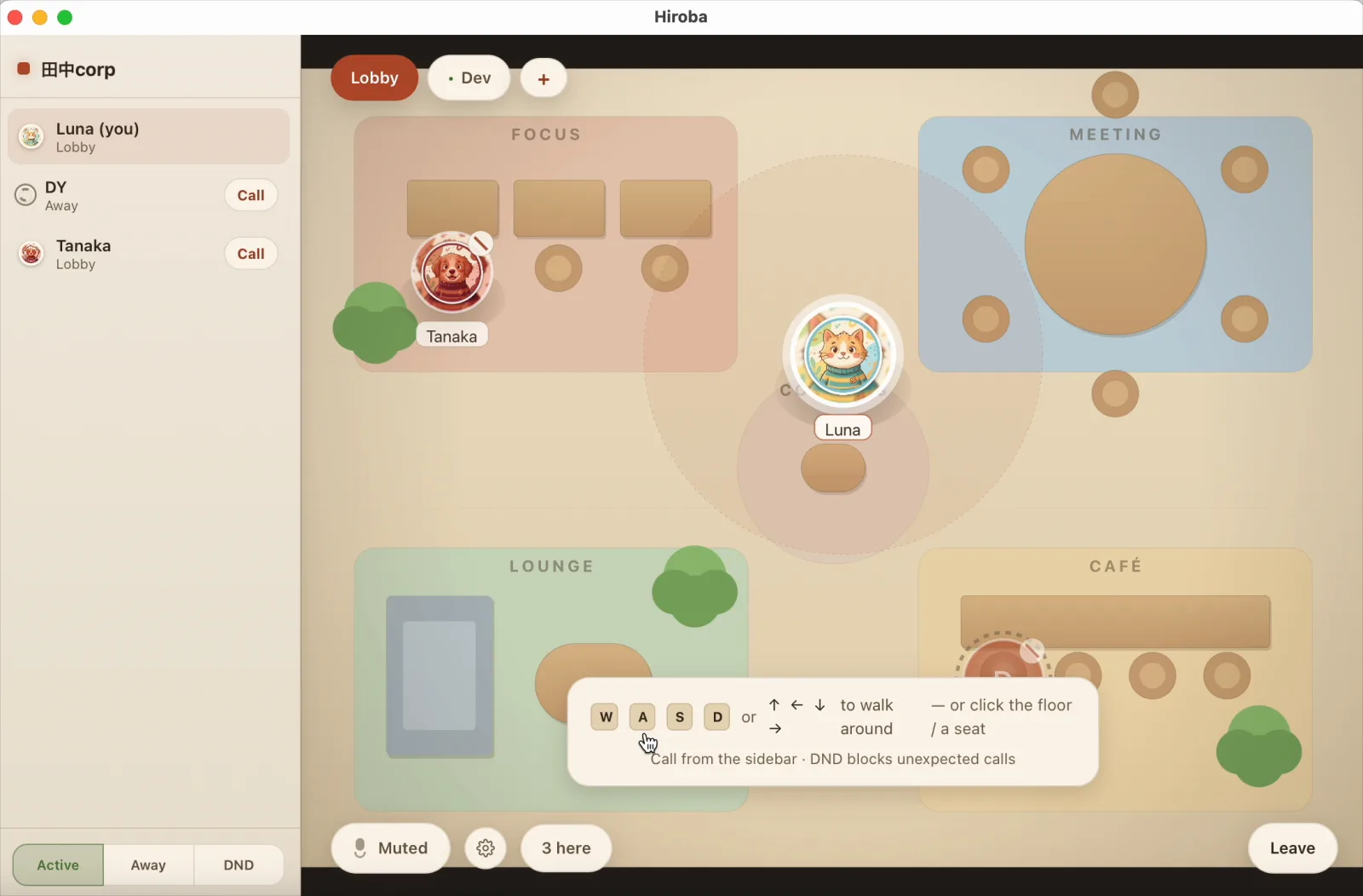
Guests don't need the app: an invite link opens the office in the browser, and they join with just a name, no account. The same link is how you can try it: the card below opens our public demo office in your browser. The hosted edition is $2 per seat per month, billed on registered members, with a 30-day trial that starts on sign-in and needs no card. The code is Apache-2.0 on GitHub, and self-hosting has no seat limits or gated features.
Best for: teams of roughly 3 to 50 who want an office that is always open and always light, and who pay attention to what a tool costs per seat.
Watch out: meetings you'd schedule and record stay in Zoom or Meet.
Which one for which team
We use Kumospace's recording, floors, and events every week
SoWork Premium for the closest match at a slightly lower price, or Gather if you want custom maps and no seat minimum. Both keep the full package.
We're a small team and the 5-seat minimum hurts
Hiroba: 3 people pay $6 a month instead of $80. SoWork Basic is $18 for 3 people if you want in-world meetings. SoWork Free and WorkAdventure Free cost nothing if their limits fit.
We have lots of guests: clients, candidates, contractors
Hiroba lets guests join from a browser link with just a name, and billing counts registered members only. WorkAdventure bills by people online at once, so occasional visitors are cheap. Check guest terms on the others during the trial.
People kept closing Kumospace because it made their laptops slow
Hiroba. It is the only option here with published idle numbers for its desktop app, CPU near 0% and about 100 MB of memory. Ten people cost $20 a month against Kumospace's $160, and the app is built to be forgotten in the background rather than closed by lunchtime.
We need it on our own servers
WorkAdventure if you want maps and in-world video and can run LiveKit and Coturn. Hiroba if you want the smallest possible footprint: one binary, optional SQLite, no media server, because audio never passes through it.
We're a large organization with procurement requirements
Kumospace Enterprise, SoWork Enterprise, or Gather Custom for SSO, SLAs, and invoicing. WorkAdventure Business includes SSO. Hiroba offers an Enterprise arrangement for invoicing on request.
Why we'd suggest trying Hiroba first
Because it is the lightest by a wide margin, and lightness is what decides whether a virtual office survives. The common failure mode is simple: the tool is heavy, so people close it; people close it, so the office is empty; the office is empty, so the subscription gets cancelled. Every design decision in Hiroba is aimed at staying open: a native client instead of a browser tab, idle CPU near 0%, about 100 MB of memory, and no video pipeline running in the background. Walking over to someone, talking, sharing a screen, turning on a camera: the things you did in a real office all work, and the machine barely notices.
The economics follow from that. At $2 per seat with no minimum, a 20-person team pays $40 a month instead of Kumospace's $320, and if you'd rather not pay at all, the Apache-2.0 server runs on a small VM with no seat limits. If our company disappeared tomorrow, the software would still be yours to run.
Once you've looked around the demo office, the trial starts automatically at sign-in, needs no card, and ends with nothing to cancel. Run it for one full working day next to your real work and see whether it's still open at the end.
Download Hiroba→Frequently asked questions
How much does Kumospace cost?
The Business plan is $16 per member per month, or 20% less on annual billing, with a minimum of 5 members. The free plan covers up to 5 registered members on one floor, with guests limited to 4 hours a week. Enterprise pricing is custom.
What is the cheapest Kumospace alternative?
On paid per-seat price, Hiroba at $2 per member per month with no minimum, then SoWork Basic at $6. For a permanent free plan, SoWork allows 10 members, WorkAdventure 10 concurrent users, and Tandem 4 members. Compare the total monthly bill for your headcount, including minimums and tiers, on the billing period you'll actually use.
Which Kumospace alternative is the lightest?
Hiroba. It is a native desktop app built with Tauri, with idle CPU near 0% and roughly 100 MB of memory. Kumospace, Gather, SoWork, and WorkAdventure run in a browser or a desktop wrapper around one and keep video pipelines warm, which is what makes them noticeable on older laptops.
Which alternative is most like Kumospace?
SoWork is the closest: a decorated office with in-world meetings, recording, analytics, and a free plan, at a lower price. Gather covers the same feature set with a pixel-art style. Tandem and Hiroba are lighter takes on the office: Tandem without a map, Hiroba with a simple floor and spatial voice.
Is there an open-source alternative to Kumospace?
Two in this list. WorkAdventure is AGPL-licensed and browser-based, with custom maps, and needs LiveKit and Coturn alongside it when self-hosted. Hiroba is Apache-2.0, a native desktop app with a single-binary server. We compare open-source options in more depth in this article.
Can guests join without installing anything?
In Hiroba, yes: an invite link opens the office in the browser and the guest enters a name, with no account. Kumospace, Gather, SoWork, and WorkAdventure also run in the browser; check each one's guest limits and whether guests count as paid seats.