Gather ended its free plan on September 15, 2025, and the Essential plan now costs $15 per member per month ($12 on annual billing). This article compares four alternatives, using prices taken from each vendor's official pricing page on August 28, 2026: Kumospace, SoWork, WorkAdventure, and Hiroba. We build Hiroba, so we've kept the table and the selection criteria neutral enough to be useful whichever one you pick.
Comparison table
Prices are per user per month in the vendor's currency, as shown on official pricing pages on August 28, 2026. Where a vendor shows both, the monthly rate is listed first and the annual-billing rate in parentheses. The table scrolls horizontally on small screens. Check each vendor's page before signing a contract; this category changes prices often.
| Product | Paid price | Billing unit | Free plan | 10 people, monthly billing | Video meetings | Runs as | Self-hosting |
|---|---|---|---|---|---|---|---|
| Gather | $15 ($12 annual) | Registered member | None since Sept 2025. 30-day trial, up to 50 people, no card | $150 | Yes, with recording and transcription | Browser, desktop app (Mac/Windows), mobile app | No |
| Kumospace | $16 (20% off annual) | Registered member, 5-seat minimum | Up to 5 members, 1 floor | $160 | Yes, with recording | Browser, desktop app (Mac/Windows), mobile app | No |
| SoWork | Basic $6 ($5.40 annual), Premium $15 ($12 annual) | Registered member | Up to 10 members, 30-minute meeting cap | $60 (Basic) / $150 (Premium) | Yes; recording and AI summaries on Premium | Browser, mobile app | No |
| WorkAdventure | Business from €8 | User | Up to 10 concurrent users | €80 | Yes | Browser | Yes (AGPL; separate commercial Enterprise edition) |
| Hiroba | $2 | Registered member | 30-day trial, starts automatically, no card | $20 | Spatial voice, screen share, and camera, all peer to peer. No scheduled meetings or recording | Native desktop app (Mac/Windows). Idle CPU near 0%, about 100 MB | Yes (Apache-2.0, single binary) |
What Gather costs now
Three things changed in 2025, and older blog posts still describe the old world:
- The free tier is gone. Gather's own support article states that after September 15, 2025 there is no free tier for either Gather 1.0 or Gather 2.0. Offices that didn't upgrade lost access. What remains is a 30-day trial for up to 50 teammates, with no card required.
- The price is $15 per user per month, or $12 on annual billing. That's the rate Gather announced for renewals after January 1, 2026. The pricing page defaults to the yearly toggle, so the first number you see is $12; switch the toggle to see the monthly rate.
- Billing moved from concurrent users to registered members. Gather 1.0 charged by how many people were online at once. Gather 2.0 charges by everyone on the roster. For a team where 40 people are registered but 15 are typically online, that roughly triples the bill.
| Gather | Before September 15, 2025 | Now |
|---|---|---|
| Free plan | Yes | None. 30-day trial for up to 50 people |
| Billing unit | Concurrent users (Gather 1.0) | Registered members (Gather 2.0) |
| Price | Depended on the concurrent-user tier | $15 per member monthly, $12 on annual billing |
For a 20-person team, that's $300 a month, or $240 on an annual commitment. The Essential plan does include a lot for that: unlimited meetings, chat, recording hours, transcription, and integrations. Whether it's worth it depends on how much of that your team actually uses, which is the first thing to check below.
Four things to check before switching
1. Which part of Gather do you actually use?
Teams use Gather for two different jobs. One is the persistent office: seeing who's around, walking over, a quick "got a sec?". The other is meetings and events: scheduled calls in a room, all-hands, onboarding sessions, the occasional game night on a custom map. Most alternatives price you for both jobs whether you need them or not. If your team already runs meetings in Zoom, Meet, or Teams and Gather is really about presence, you can pay a fraction of the price for a tool that only does the first job. If the custom map and in-world meetings are the point, you want a tool that keeps both.
2. Billing unit and minimums
Every product here except WorkAdventure bills per registered member, the model Gather moved to. Two details change the real number: minimum seats (Kumospace requires 5 paid seats, so a 3-person team pays $80) and whether the price shown is monthly or annual (Gather, Kumospace, and SoWork all default to showing the discounted annual rate). Work out your team's monthly cost on monthly billing first, then decide whether an annual commitment is worth it.
3. Can it stay open all day without slowing down laptops?
A virtual office is only an office if people leave it open. Most tools in this category run in a browser tab and keep video pipelines warm, and on a three-year-old laptop that shows up as fan noise and a sluggish IDE. The practical test: during the trial, ask your team to keep it open for a full working day alongside their real work, and check whether it's still open at 5 pm. Tools that get closed at 11 am become empty offices, and empty offices get cancelled. Of the four alternatives, only Hiroba is built as a native desktop app with published idle numbers (CPU near 0%, about 100 MB of memory); the other three run in a browser tab.
4. What happens when the vendor changes course?
Gather removing its free tier is the mild version of this. The category has seen real shutdowns; we documented several in a Japanese-language post after two services disappeared within a year. Two things protect you: a self-hosting option and an open-source license. Only WorkAdventure and Hiroba offer both in this list. For everyone else, at least check that you can export your data and that pricing changes come with notice.
The alternatives, one by one
Kumospace
Kumospace is the closest thing to a like-for-like Gather replacement for teams that want the whole package. The space is a stylized 2D office rather than pixel art, with proximity audio and video, chat channels, recording, analytics, and multiple floors on the paid plan. It runs in the browser and also has desktop apps for Windows and macOS plus iOS and Android apps. Pricing is $16 per member per month with a 5-seat minimum and a 20% discount for annual billing; the free plan covers up to 5 registered members on a single floor. Enterprise adds SSO, a custom domain, HIPAA compliance, and an uptime SLA.
Best for: teams of 10 to a few hundred who want meetings, chat, and the office in one product and don't mind paying more than Gather for it.
Watch out: it's the most expensive option per seat here, and the 5-seat minimum makes it awkward for very small teams.
SoWork
SoWork is a 2.5D isometric office with customizable avatars, and it positions itself directly against Gather on price and productivity features. The Basic plan is $6 per member per month ($5.40 annual), and Premium is $15 ($12 annual), which adds unlimited recordings, AI meeting summaries and transcripts, chat integrations, team analytics, and noise cancellation. The free plan allows up to 10 members with a 30-minute cap on meetings. It runs in the browser with iOS and Android apps; we couldn't find a native desktop app documented on the pricing page. The company raised a $15 million seed round in February 2026, which is a reasonable signal that it isn't going anywhere soon.
Best for: teams that want the Gather-style world and in-world meetings at a lower price, especially if the Basic tier covers what they need.
Watch out: the interesting features (recording, AI summaries) live on Premium, which costs the same as Gather.
WorkAdventure
WorkAdventure is a French open-source virtual office: 2D top-down maps built with the Tiled editor, with proximity-triggered audio, video, and text bubbles. It runs in the browser. The hosted version is free for up to 10 concurrent users, then from €8 per user per month on the Business plan, with an Event plan at €4 per user per day for one-off gatherings. The core is licensed under the AGPL and can be self-hosted with Docker Compose or a Helm chart; a separately licensed Enterprise edition covers some features and support. Self-hosting in practice means running three services with public addresses (WorkAdventure itself, LiveKit for media, and Coturn for NAT traversal), so budget for someone comfortable with Docker or Kubernetes.
Best for: organizations that need data on their own infrastructure and have an engineer or IT team to run it; also anyone who wants Gather-style custom maps in an open-source tool.
Watch out: the AGPL matters if you plan to modify and redistribute; the self-hosting footprint is real; and it's browser-only, so the all-day-open test in section 3 applies.
Hiroba
Hiroba is the product we make, and it is the ultra-light option in this list. It is a native Tauri desktop app for macOS and Windows, not a browser tab or an Electron bundle, designed around one target: idle CPU near 0% and about 100 MB of memory, so it can stay open from morning to evening without fans spinning or the IDE slowing down. Your organization gets a floor with a lobby and team rooms. Your avatar shows you're around; walking near someone fades in spatial voice; a Call button pages anyone in another room; and inside a call you can share your screen or turn on your camera. Audio and video go WebRTC peer to peer and never pass through the server, which is why the server is a single Rust binary that only relays presence and positions.
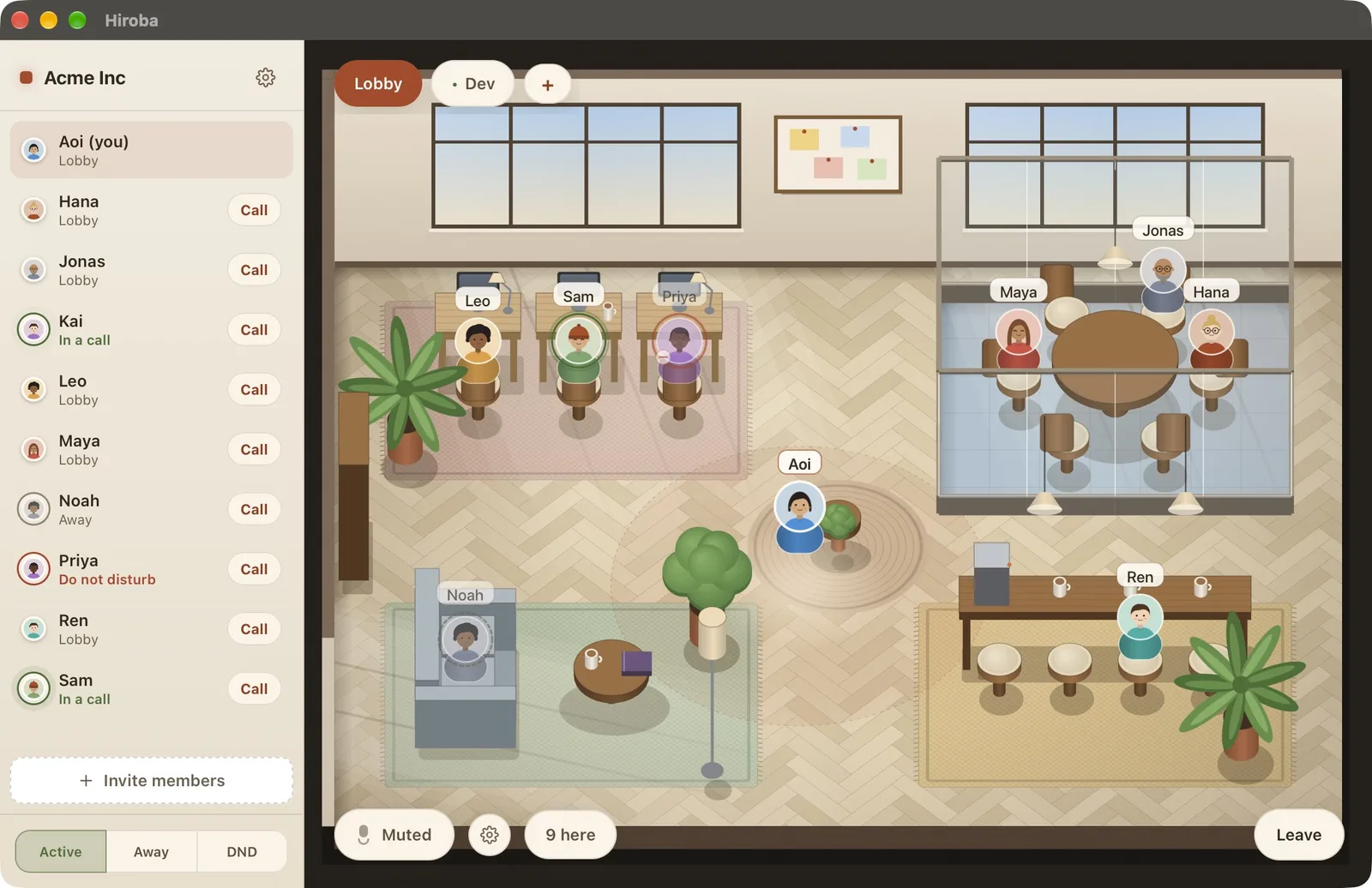
It is also the cheapest: $2 per seat per month on the hosted edition, with a 30-day trial that starts on sign-in and needs no card. The code is Apache-2.0 on GitHub, and self-hosting has no seat limits or gated features.
Best for: teams of roughly 3 to 50 who want an office that is always open and always light, and who pay attention to what a tool costs per seat.
Watch out: there are no scheduled meetings or recording (meetings stay in Zoom or Meet), no mobile app, no custom maps, and no SSO yet.
Which one for which team
We use Gather's meetings, recording, and custom maps every day
SoWork Premium at the same price as Gather, or Kumospace if you'd rather have desktop apps and a more office-like look. Both keep the full package.
We want a free plan, not a trial
SoWork Free (10 members, 30-minute meetings) is the widest. Kumospace Free covers 5 members. WorkAdventure is free for 10 concurrent users. Hiroba has no permanent free plan, only a 30-day trial with everything included.
We need it on our own servers
WorkAdventure if you want maps and video and can run LiveKit and Coturn. Hiroba if you want the smallest possible footprint: one binary, optional SQLite, no media server, because audio never passes through it.
People kept closing Gather because it made their laptops slow
Hiroba. It is the only native app in the list, with idle CPU near 0% and about 100 MB of memory. Ten people cost $20 a month against Gather's $150, and the app is built to be forgotten in the background rather than closed by lunchtime.
We're a large organization with procurement requirements
Kumospace Enterprise or SoWork Enterprise for SSO, SCIM, SLAs, and invoicing. Gather's Custom plan also covers this. Hiroba offers an Enterprise arrangement for invoicing on request, but doesn't have SSO today.
Why we'd suggest trying Hiroba first
Because it is the lightest by a wide margin, and lightness is what decides whether a virtual office survives. The common failure mode is simple: the tool is heavy, so people close it; people close it, so the office is empty; the office is empty, so the subscription gets cancelled. Every design decision in Hiroba is aimed at staying open: a native client instead of a browser tab, idle CPU near 0%, about 100 MB of memory, and no video pipeline running in the background. Walking over to someone, talking, sharing a screen, turning on a camera: the things you did in a real office all work, and the machine barely notices.
The economics follow from that. At $2 per seat, a 20-person team pays $40 a month instead of Gather's $300, and if you'd rather not pay at all, the Apache-2.0 server runs on a small VM with no seat limits. If our company disappeared tomorrow, the software would still be yours to run. In a category where products vanish, only WorkAdventure and Hiroba can honestly say that.
The trial starts automatically at sign-in, needs no card, and ends with nothing to cancel. Run it for one full working day next to your real work and see whether it's still open at the end. Self-hosting instructions are in the repository.
Download Hiroba→Frequently asked questions
Is Gather still free?
No. Gather removed its free tier on September 15, 2025. The only free option now is a 30-day trial for up to 50 teammates. After that, the Essential plan is $15 per member per month, or $12 on annual billing.
What is the cheapest Gather alternative?
On paid per-seat price, Hiroba at $2 per member per month, then SoWork Basic at $6. If you want a permanent free plan, SoWork allows 10 members, WorkAdventure 10 concurrent users, and Kumospace 5 members. The right comparison is the total monthly bill for your headcount, including any seat minimums, on the billing period you'll actually use.
Is there an open-source alternative to Gather?
Two in this list. WorkAdventure is AGPL-licensed, browser-based, with Gather-style custom maps, and needs LiveKit and Coturn alongside it when self-hosted. Hiroba is Apache-2.0, a native desktop app with a single-binary server, and covers presence and voice rather than meetings. We compare open-source options in more depth in this article.
Which Gather alternative is the lightest?
Hiroba. It is the only option in this list that runs as a native desktop app rather than in a browser, with idle CPU near 0% and roughly 100 MB of memory. Kumospace, SoWork, WorkAdventure, and Gather itself all run in a browser tab (or a desktop wrapper around one) and keep video pipelines warm, which is what makes them noticeable on older laptops.
Which alternative is most like Gather?
SoWork is the closest in feel (a decorated 2D world with in-world meetings) and prices itself against Gather directly. Kumospace covers the same feature set with a more realistic office style. WorkAdventure is the closest open-source match for custom maps. Hiroba is the least like Gather in looks: no decorated map, just a light floor with presence, voice, screen share, and camera.
Can I use one of these alongside Zoom or Google Meet?
All of them. Hiroba assumes it: scheduled meetings stay in your meeting tool, and Hiroba is the light, always-open office for the hours between them.